Why One Room in Your House Never Gets as Cold as the Rest
The AC is probably fine. The problem is usually sitting in the attic, in the ductwork nobody ever looks at.
August 25, 2026 · 3 min read
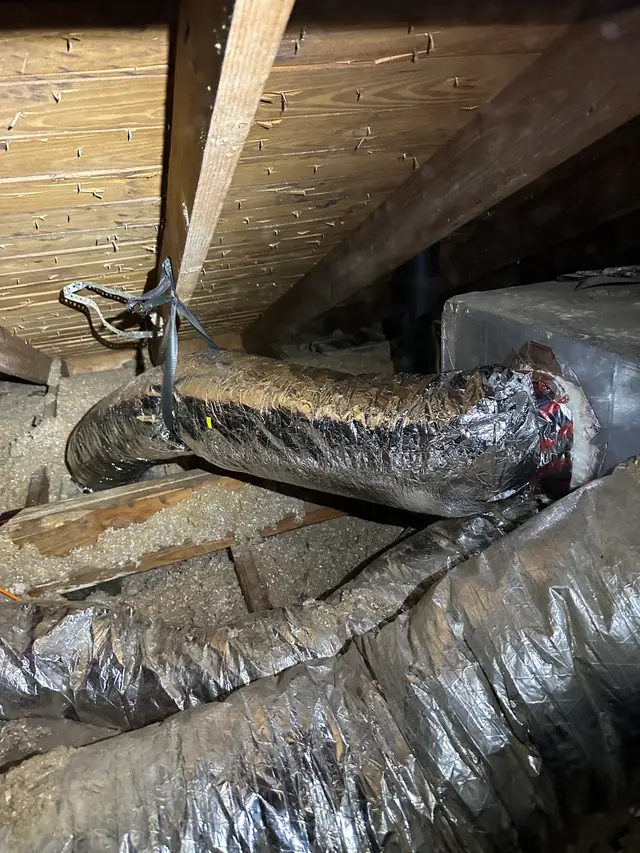
It's one of the most common complaints we hear, and it's almost never about the AC unit itself. One bedroom, or a home office, or a room over the garage runs several degrees warmer than the rest of the house no matter how low the thermostat goes. The rest of the house is comfortable, so the system clearly works. The problem is usually sitting in the attic, in ductwork nobody ever looks at because nobody can see it.
The air has to survive a trip through the attic first
Cooled air doesn't travel from the air handler to a vent in a straight line. It runs through flexible or rigid ductwork routed through the attic, often twenty or thirty feet of it, through a space that can hit well over 130 degrees on a summer afternoon. Every foot of that trip is an opportunity for the cooled air to pick up heat back from its surroundings, lose pressure through a leak, or get choked down by a duct that's kinked, crushed, or undersized for the room it's feeding.
A crushed or kinked run is the single most common cause
Flexible duct is easy to install and easy to damage. It gets stepped on during other attic work, crimped where it turns a tight corner, or compressed under insulation that was blown in after the ductwork was already run. A kink doesn't stop airflow entirely, which is exactly why it goes unnoticed. It just reduces it, so the room at the end of that run gets a fraction of the air it's supposed to, while every other room on a straighter run gets its full share.
Leaks lose conditioned air before it ever reaches the vent
Every joint, connection, and boot in a duct system is a potential leak point, and ductwork put in by a home's original builder is frequently the weakest link, not because anyone did anything egregiously wrong, but because it's fast, low-visibility work that nobody checks again once the drywall goes up. A duct leaking into a 130 degree attic is dumping cooled air into the worst possible place for it and pulling in hot attic air on the return side to replace it. One of our recent jobs was exactly this. Builder-installed ductwork that had never been right, corrected and re-routed properly, with a media filter added in the attic system at the same time.
Static pressure is the part nobody thinks to check
Every duct run has resistance, and a system has to push against all of it to move air. Too many bends, a run that's too long, or ductwork that's undersized for the length it has to cover all add up to what technicians call static pressure. High static pressure anywhere in the system reduces total airflow everywhere, but the rooms furthest from the air handler, or on the least direct run, feel it first and worst. That's usually the room that never gets cold. It's not that the system doesn't have enough capacity. It's that the path to that specific room is fighting the system the whole way.
It's easy to blame the thermostat location instead
A lot of homeowners assume the fix is a second thermostat, or moving the existing one, because the room that reads warm on the wall panel is a different room from the one that actually feels warm. That can genuinely be part of it in an open floor plan, but it's worth ruling out the ductwork first. Moving a thermostat doesn't add any airflow to a room that isn't getting its fair share, it just changes which room the system is reacting to. If the underlying duct run is still choked down, a new thermostat location just moves the complaint to wherever the sensor happens to be.
What actually fixes it
- A static pressure and airflow test to confirm where the loss is actually happening
- Physical inspection of the duct run to that room for kinks, crushed sections, or disconnected joints
- Sealing leaks at connections and boots rather than just patching the obvious ones
- Re-routing or replacing a run that's genuinely too long, too kinked, or undersized for the room
- Insulation upgrades on the duct itself where it's exposed to full attic heat
This is attic work, not guesswork, and it's exactly the kind of job LaFitte HVAC has been doing across Conroe and Montgomery County since 2007 under Texas licence TACLA27440C. If one room in your house has never gotten properly cold, call (936) 672-7696 and have someone actually look at the ductwork instead of assuming the AC is undersized.
LaFitte HVAC LLC, (936) 672-7696
Call (936) 672-7696More articles
Your AC Is Running But the House Won't Cool Down: Here's Why
A running condenser and a warm house point to one of a short list of specific parts, not a dying system.
Repair or Replace? A Way to Think It Through That Doesn't Depend on Trust
There's no single rule for when a system is done, but there is a way to reason through it that keeps the decision in your hands.