Your AC Is Running But the House Won't Cool Down: Here's Why
A running condenser and a warm house point to one of a short list of specific parts, not a dying system.
August 25, 2026 · 4 min read
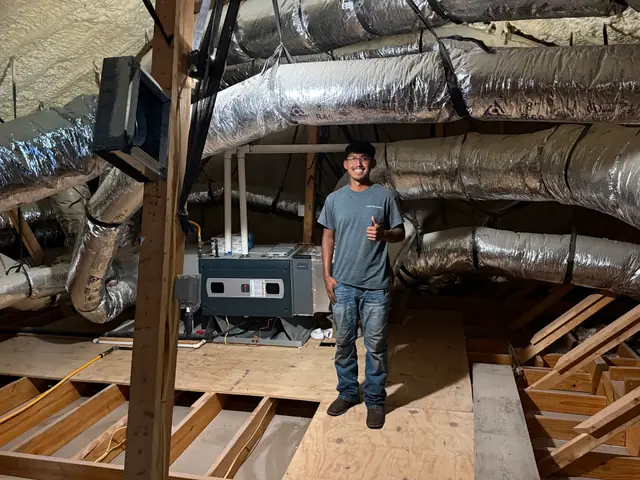
You come home, the thermostat says 78 and climbing, and the outdoor unit is running like nothing's wrong. That's the most common AC complaint we get in Conroe, and it usually isn't one big catastrophic failure. It's one of a handful of specific parts doing its job badly, and a technician who's seen a few thousand of these calls knows which one to check first instead of guessing.
Start with what the system is actually doing
Before anyone touches a wrench, the first read is simple. Is the outdoor unit, the condenser, actually running. Is the indoor blower moving air. And is the air coming out of the vents cold, warm, or barely moving at all. Those three answers narrow the problem fast. A condenser that won't start points one direction. A condenser that runs fine while the air inside stays warm points somewhere else entirely. Jumping straight to 'it needs a new unit' before answering those three questions is exactly how homeowners end up paying for equipment they never needed.
The capacitor is usually the first suspect, and it's a cheap one
Most emergency calls for an outdoor fan that's stuck, or a compressor that hums but won't start, trace back to a start or run capacitor. It's a small cylindrical part that gives the compressor and fan motor the jolt they need to get spinning, and Texas heat is hard on it. Capacitors are rated in microfarads and they weaken with heat and age rather than failing all at once, so a system can limp along for weeks with a capacitor that's already testing low before it finally quits on the hottest afternoon of the summer. A technician checks it early because it's cheap, it's fast to replace, and it rules out the most common cause before anyone starts guessing at something bigger.
Airflow problems masquerade as bigger failures
If the compressor and fan are both running fine but the air at the vents is weak or barely cool, the next place to look is airflow, not refrigerant. A dirty filter is the most common cause and the easiest one to rule out yourself. Past the filter, a coil caked in dust restricts airflow the same way, just further into the system, and a blower wheel losing speed has the same effect from the other end. Restricted airflow makes the evaporator coil run colder than it's designed to, and it can eventually freeze the coil solid. A frozen coil gets misread as 'it's out of refrigerant' constantly, when the real cause is upstream of the refrigerant entirely and no amount of topping off the system will fix it.
Refrigerant is almost always a symptom, not a cause
A sealed AC system doesn't use up refrigerant the way a car uses gas. If a system is running low, refrigerant is leaking out somewhere, and topping it off without finding the leak just buys a few more weeks before the same call comes back. A proper diagnosis includes an actual leak search, not just a gauge reading and a refill. That distinction is the difference between fixing the problem once and paying for the same service call again in a few weeks.
Sometimes it isn't the air conditioner at all
A thermostat with a dead battery or a wrong setting, a tripped breaker, a condensate drain line clogged enough to trip its safety float switch and shut the whole system down on purpose. None of these have anything to do with compressors or refrigerant, and they're worth ruling out before assuming the worst. A clogged condensate line is especially common in a humid climate like ours, and it gets missed constantly because the symptom looks identical to a real breakdown. The system just stops.
What you can check before anyone shows up
- Swap or check the air filter first, a clogged one causes more 'no cooling' calls than anything else
- Confirm the thermostat is set to Cool, the fan to Auto, and the temperature is actually below room temperature
- Check the breaker panel for a tripped switch, especially after a storm
- Look at the outdoor unit for debris, leaves, or grass clippings packed against the coil
- Check for water pooled near the indoor air handler, which usually means a clogged condensate line
- Resist the urge to keep flipping the system off and on, it doesn't fix anything and can trip the compressor's protective delay
LaFitte HVAC has been running down exactly this kind of call in Conroe and across Montgomery County since 2007, checking these in the order that actually finds the answer instead of guessing at parts. Jason LaFitte's team is Texas licensed under TACLA27440C. If your AC is running but the house won't cool down, call (936) 672-7696.
LaFitte HVAC LLC, (936) 672-7696
Call (936) 672-7696More articles
Repair or Replace? A Way to Think It Through That Doesn't Depend on Trust
There's no single rule for when a system is done, but there is a way to reason through it that keeps the decision in your hands.
What a Maintenance Visit Actually Checks, and Why Spring Is the Time
A maintenance visit isn't a formality. Here's what a technician is actually looking at, and why the timing matters as much as the visit itself.